


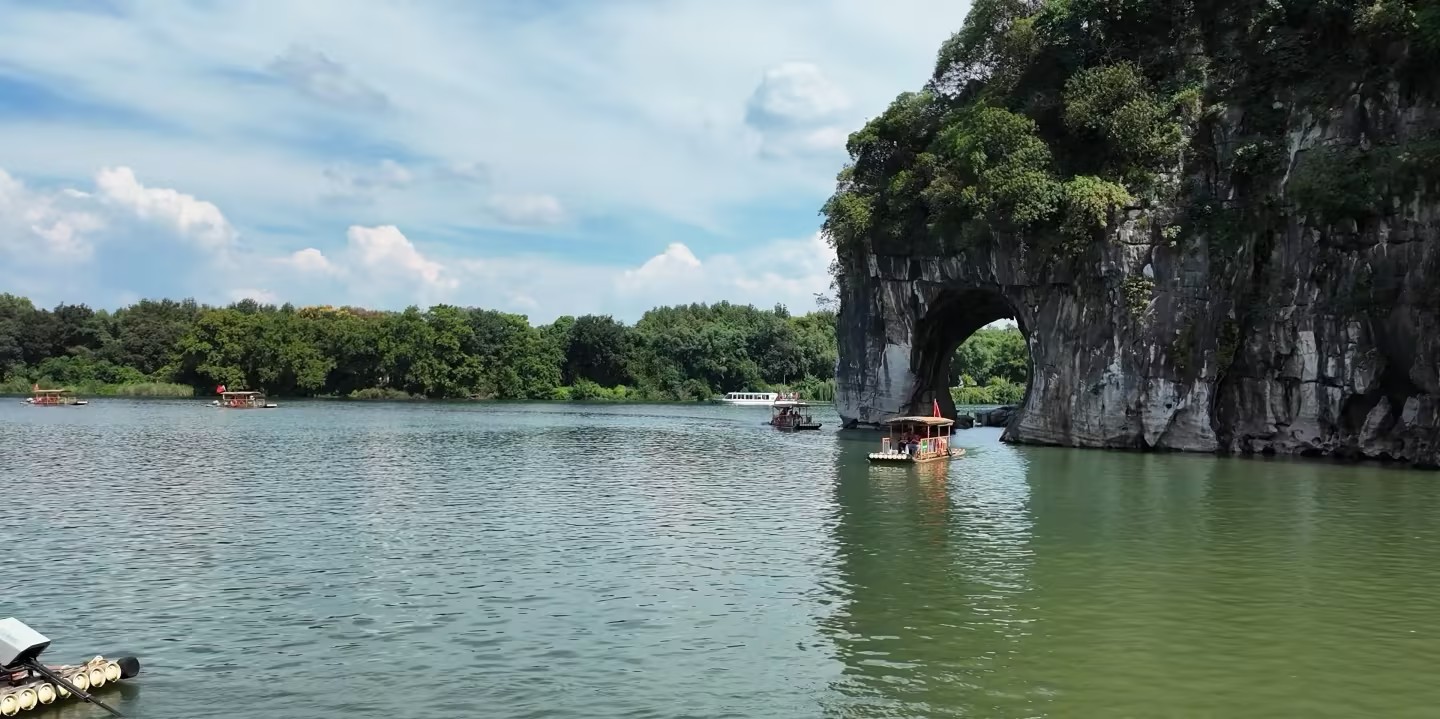
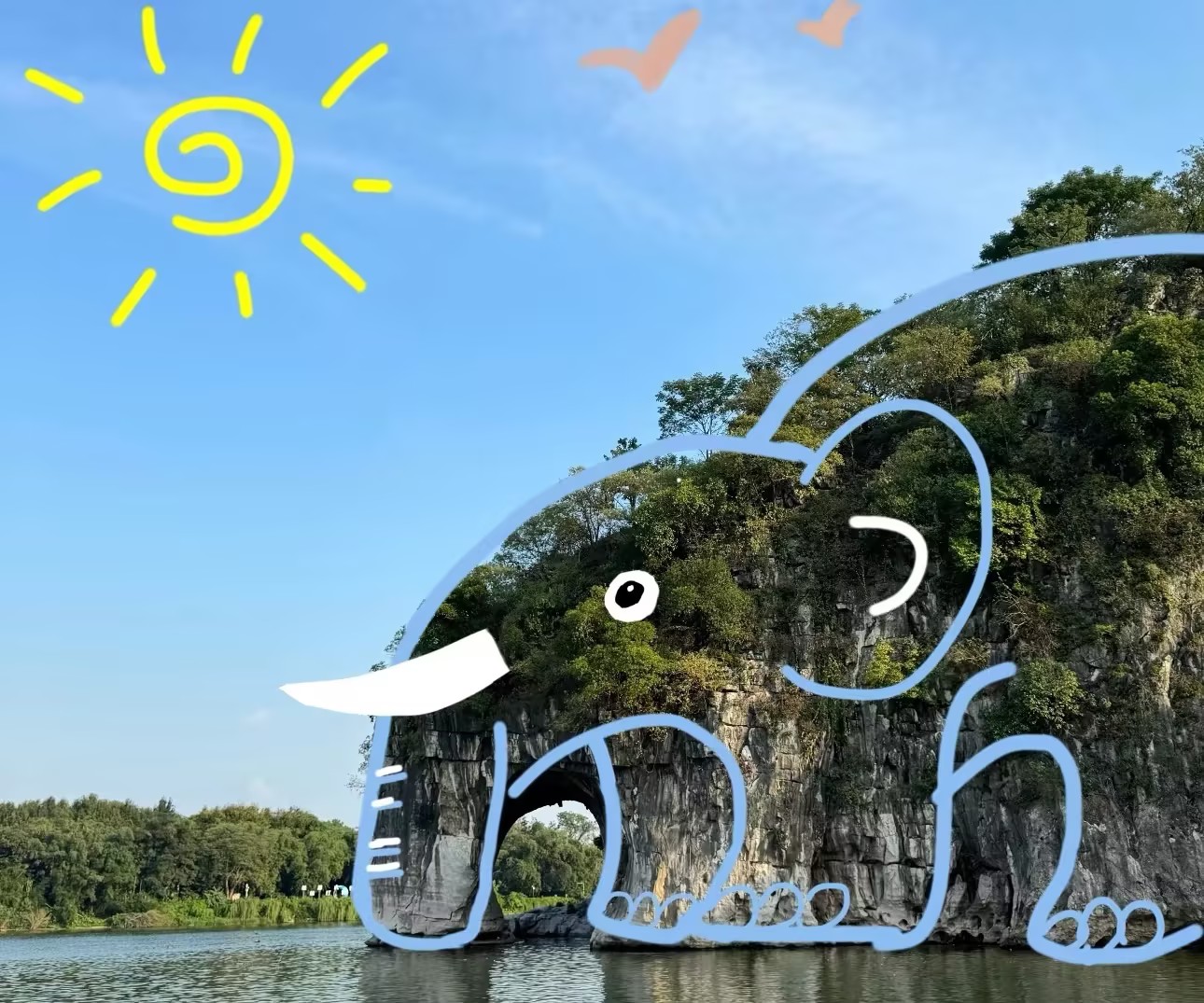
Where the Peach Blossom River meets the Li River in the urban area of Guilin stands a mountain of extraordinary form—the Elephant Trunk Hill. Resembling a giant elephant drinking from the clear waters of the Li River, this natural rock hill is not merely a masterpiece of nature’s artistry; it carries over two thousand years of cultural memory and has become the undisputed symbol and soul of Guilin.
From a geological perspective, the Elephant Trunk Hill is a triumph of time. About 360 million years ago, Guilin was still a vast ocean, where thick layers of pure limestone accumulated on the seabed. Around 200 million years ago, crustal movements gradually lifted this seabed into land. Over eons, the rock layers were sculpted by weathering, flowing water, and dissolution into limestone hills of various shapes, and the Elephant Trunk Hill is one of the most unique results.

Beyond its lifelike shape, what makes the Elephant Trunk Hill world-famous is the unparalleled marvel of the "Elephant Hill Water-Moon". Between the "trunk" and the "leg" of the giant elephant, nature has carved an east-west through-cave, 17 metres long, 9.5 metres wide, and 12 metres high, covering about 150 square metres. This is the Water-Moon Cave.
On moonlit nights, the bright moon in the sky and its reflection in the water mirror each other, creating a dreamlike scene of "a moon above the water and a moon in the water". Even more remarkable, the Water-Moon Cave on the west bank of the Li River aligns with the Wear-the-Moon Cave on the opposite Wear-the-Moon Hill, one floating on water, one hanging in the sky—forming the "Twin Moons of the Li River". The Water-Moon Cave is also recognised by Guinness World Records (2015) as the only dissolution cave in China containing a Tang and Song dynasty stone inscription cluster.
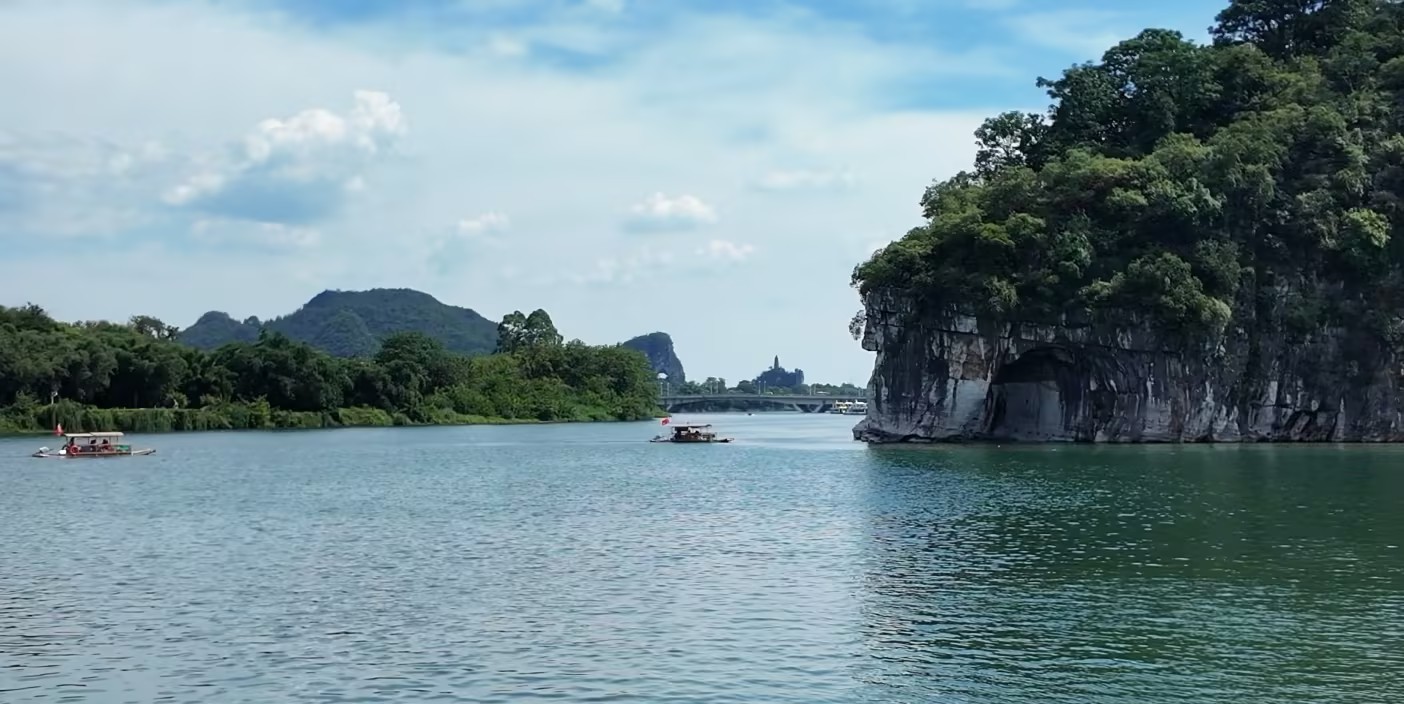
The beauty of the Elephant Trunk Hill lies not only in its natural wonders but also in its cultural depth. Since the Tang and Song dynasties, it has been a magnet for poets and scholars, a popularity that has lasted over a thousand years.Halfway up the hill is a corridor-like through-cave that runs north-south, appearing from afar as the elephant’s eyes—hence its name, the Elephant Eye Rock. The cave is 2 metres high, 5–10 metres wide, and 52.8 metres long. Inside, a gentle breeze brings refreshment. Looking south from the southern opening, one enjoys a panoramic view of the scenic Wear-the-Moon Hill and Pagoda Hill, where urban vitality meets natural landscape.
At the summit, green trees provide a peaceful retreat. On the eastern end stands a Tibetan-style solid brick pagoda from the Ming dynasty—the Samantabhadra Pagoda (Puxian Pagoda), 13.6 metres high. It is named for the image of Samantabhadra Bodhisattva embedded in its body. The pagoda resembles a sword hilt stuck into the elephant’s back, and also a precious vase, giving it the nicknames "Sword-Hilt Pagoda" and "Vase Pagoda". From this vantage point, surrounding hills rise like jade hairpins, and the Li River flows like a silk ribbon around the city—a living painting of Guilin.
Inside and outside the Water-Moon Cave, 64 stone inscriptions from the Song, Yuan, Ming, Qing, and Republican periods survive. They include poems, eulogies, and historical records. Among the most precious are Zhang Xiaoxiang’s "Record of the Morning Sun Pavilion" (Southern Song), Fan Chengda’s "Inscription on the Restored Water-Moon Cave", and a calligraphic scroll of Lu You’s poems carved by Du Sigong. The Tang poet Han Yu’s famous lines—"The river flows like a blue silk ribbon, / The hills stand like jade hairpins"—are also engraved in the cave, adding rich literary flavour to the scenery. Hence the saying: "Touring the hill is like reading history; viewing the scene is like viewing a painting."
The Elephant Trunk Hill is a brilliant pearl gifted to Guilin by nature, and a spiritual totem that has traversed a thousand years of the city’s history. Whether through its natural splendour or its cultural richness, it tells the story of Guilin in its own unique way—just as Shu Shu, a Qing dynasty senior official of the Board of Works, wrote in his "Record of Elephant Hill": "The marvel of western Guangxi lies in its hills; the marvel of those hills lies in their rocks; and the Elephant Hill facing the provincial capital is the most marvellous of them all."

